
Most couples booking an outdoor wedding discover the bathroom problem late, the venue is beautiful, the tent is booked, and there’s no plumbing within 200 feet of it. The decision that follows matters more than it sounds, because restrooms are one of the few wedding details every single guest will use.
For most weddings, a VIP restroom trailer is the right answer: private stalls, flushing toilets, vanity sinks, lighting, and climate control in one delivery, typically $600–$1,200 per day for a 2–3 stall unit. Deluxe flushable porta potties at $150–$250 per day are the value alternative when the budget or the venue can’t take a trailer. Standard units belong in the vendor and staff area, not in front of guests.
Here’s how the four options compare, how many you need, what it costs, and what to check at your venue before booking.
| Option | What Guests Get | Wedding Role | Typical Daily Rate |
|---|---|---|---|
| VIP restroom trailer (2–3 stalls) | Private suites, flushing china toilets, vanity sinks, mirrors, lighting, climate control | Main guest restrooms | $600 – $1,200 |
| Deluxe flushable porta potty | Flushing toilet, built-in sink, more finished interior | Value option, or guest overflow | $150 – $250 per unit |
| ADA-compliant unit | Ground-level entry, wide door, grab bars, room to turn | Accessibility for guests who need it | $175 – $300 per unit |
| Standard porta potty | Toilet, urinal, toilet paper, sanitizer | Vendors, staff, back-of-house | $100 – $175 per unit |
Typical 2026 pricing. Final quotes depend on location, dates, unit count, and servicing.
The 4 Wedding Restroom Options, Ranked
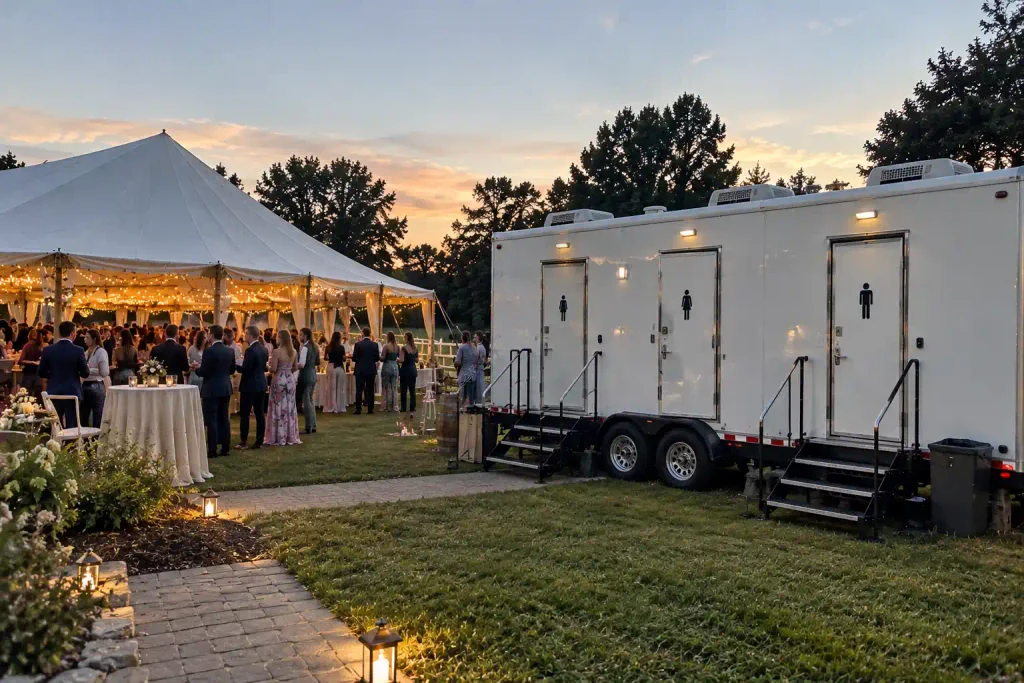
1. VIP Restroom Trailer — Best Overall
A VIP restroom trailer is a towed unit with separate private suites, flushing toilets, countertop vanity sinks with mirrors, interior lighting, and usually heating and air conditioning. It’s the only option that feels like an indoor bathroom.
Why it wins for weddings:
- Guests are dressed up. A bride in a gown, guests in heels, bridesmaids fixing makeup,a vanity and a mirror solve problems a porta potty can’t.
- Climate control. August heat and October cold both become non-issues.
- Capacity in one delivery. A 2-stall trailer comfortably serves roughly 50–75 guests, according to published provider guidance, so several stalls arrive as one unit rather than a row of separate cabins.
- It photographs fine. Guests walk to a discreet trailer, not a line of blue boxes at the edge of the tent.
The catch: a trailer needs level, firm ground, a clear tow route wide enough to get in, and in most cases a power source. Check those three things before you fall in love with the idea.
2. Deluxe Flushable Porta Potty — Best Value
A deluxe flushable porta potty has a flushing toilet fed by a fresh water tank plus a compact sink inside the same cabin, usually with a foot pump so nobody touches a handle.
Choose this when:
- The trailer doesn’t fit the budget
- The venue can’t take a towed unit or has no power
- You need guest overflow alongside a trailer
- The wedding is small — an intimate backyard ceremony of 30–40 guests is well served by two or three deluxe units
It’s a genuine step up from a standard unit: guests flush and wash inside, and the interior is more finished. It isn’t a trailer, and it won’t feel like one, but at roughly $50–$100 more per unit per day than a standard toilet it’s the best value upgrade in the category. Rapid also offers flushable portable toilets if flushing matters more than an interior sink.
3. ADA-Compliant Unit — Not Optional for Most Weddings
An ADA-compliant unit has ground-level entry, a wide door, grab bars, and enough interior space for a wheelchair to turn. Rapid also offers handicap portable toilets.
Nearly every wedding guest list includes grandparents, someone recovering from surgery, or a guest who uses a wheelchair or walker. Beyond hospitality, there’s a standard: the U.S. Access Board’s guide to the 2010 ADA Standards explains that where single-user portable units are clustered at one location, at least 5% of them, and never fewer than one per cluster, must be accessible.
Practical version: if you’re putting porta potties out, put at least one accessible unit in each group of them. Place it on firm, level ground with a clear, flat path from the tent. A beautiful accessible unit at the bottom of a grass slope helps nobody.
4. Standard Porta Potty — Staff, Vendors, and Overflow
A standard porta potty is the basic non-flushing unit with a toilet, urinal, toilet paper, and a hand sanitizer dispenser.
It has a real role at a wedding, just not a guest-facing one. Caterers, the band, the photography team, and the setup crew are on site for hours before guests arrive and will otherwise use the guest restrooms all afternoon. One or two standard units in the back-of-house area keeps guest capacity where you paid for it.
If you use standard units anywhere guests can reach them, add a handwashing station beside them. Guests will not use a restroom with no way to wash.
How Many Restrooms Does Your Wedding Need?
Published guidance ranges from one unit per 25 guests up to one per 75, which is why couples get three different answers from three companies. The honest version is a range, with the low end covering a short afternoon reception without a bar and the high end covering a long evening with drinks — which is where most weddings land.
| Guests | Units Needed | Notes |
|---|---|---|
| 50-100 | 1 – 2 | Two covers most short receptions |
| 100-250 | 3 – 4 | A 6-hour reception with a bar needs 4 |
| 250-350 | 5 – 6 | Most mid-size weddings sit near the top once the bar opens |
| 350-500 | 5 – 7 | Split into two clusters rather than one bank |
| 500-1000 | 8 – 10+ | Consider a trailer plus standard units for staff |
Ranges reflect published industry planning guidance. Include at least one accessible unit in each cluster.
If you’re using a restroom trailer, count stalls rather than units: a 2-stall trailer serves roughly 50–75 guests by common provider guidance, so a 150-guest wedding often means a larger trailer, two trailers, or a trailer plus deluxe units.
What Pushes the Number Up
- Length. The baseline assumes about four hours. Guidance commonly adds 10–15% more capacity for every additional two hours. A ceremony at 4pm and a last dance at 11pm is a long event.
- Alcohol. Providers commonly recommend adding 15–20% when a bar is running, and some go higher. An open bar at a 6-hour, 150-guest wedding can move the count from 3 units to 4 or 5.
- Heat. Warm weather increases both drinking and restroom use.
- Surge moments. Everyone goes right after the ceremony, right after dinner, and just before the last dance. Sizing for the average misses the three moments guests actually remember.
- Guest mix. A crowd skewing female needs more capacity than a headcount suggests, since average visit times differ.
Don’t Forget Your Vendors
Add your vendor headcount to your guest count before you order. A 150-guest wedding often carries 15–25 vendors and staff across catering, bar, band or DJ, photo and video, planners, and rentals. They’re on site longer than anyone.
What Does a Wedding Porta Potty Rental Cost?
A realistic wedding restroom budget:
| Setup | Typical Cost |
|---|---|
| 2–3 stall VIP restroom trailer | $600 – $1,200 |
| 4 deluxe flushable units + 1 ADA unit | $775 – $1,300 |
| Trailer + 2 standard units for vendors | $800 – $1,550 |
| 2 deluxe units (small backyard wedding) | $300 – $500 |
Estimates using typical 2026 rates, before taxes and location-specific fees. Nationally, published wedding restroom figures vary widely by market, one bridal guide cites Connecticut wedding bathroom rentals at roughly $1,750 to $2,500, and several trailer specialists quote weekend trailer packages in the $1,500–$2,800 range.
Two things shift the number: when and where. Peak-season Saturdays book first, and delivery distance from the provider’s yard affects the quote. Booking early gives you the unit you want rather than the one still available.
The Per-Guest Math
This is the calculation that settles the trailer debate. One provider frames it clearly: a $200 porta potty at a 150-guest wedding works out to about $1.33 per guest for a restroom guests resent using, while a $1,500 trailer is roughly $10 per guest for a restroom that matches the event.
Run it against your own numbers. On a wedding where catering alone is running $80–$150 per head, $8–$12 per guest for restrooms every attendee will use at least once is not the line to cut. On a small backyard wedding with a modest total budget, deluxe flushable units at a few hundred dollars are the sensible call — and there’s nothing wrong with that answer.
Which Setup Fits Your Wedding?
| Your Wedding | Recommended Setup |
|---|---|
| Backyard, 30–50 guests, afternoon | 2 deluxe flushable units, one of them accessible if needed |
| Backyard or farm, 100 guests, evening with bar | 1 trailer, or 3–4 deluxe units + 1 ADA unit |
| Tented estate or vineyard, 150 guests | Trailer in the guest area + 1–2 standard units for vendors + 1 ADA unit |
| Barn or venue with limited indoor bathrooms | Trailer or deluxe units to supplement, placed near the tent |
| 250+ guests | Trailer(s) front-of-house + a bank of standard units back-of-house |
| Remote site, no power, no tow access | Deluxe flushable units + a handwashing station |
| Two-day celebration (welcome party + wedding) | Multi-day rental with a service visit scheduled between days |
The hybrid approach, trailer for guests, standard units for staff and overflow, is the most common setup at larger weddings for a reason. It keeps the guest experience high and the per-unit cost controlled.
What to Check at Your Venue Before You Book
Walk the site with these in mind, ideally before you sign a rental agreement:
- Ground. Trailers and units need level, firm ground. Soft grass after a week of rain is a problem for anything towed.
- Access route. Measure gate widths and driveway turns. A trailer that can’t reach the spot is a wedding-week emergency.
- Power. Most trailers need a power source for lighting and climate control. Confirm whether the venue has one or whether a generator is needed.
- Water. Some trailers can run from onboard tanks; others prefer a water hookup. Ask what your unit requires.
- Distance from the tent. Close enough that guests in heels will walk it at night, far enough to be out of photos and away from the dance floor and catering.
- The path at night. A restroom guests can’t find in the dark may as well not exist. Plan lighting along the route.
- Service truck parking. For multi-day rentals, a technician needs to reach the unit with a hose and pump line.
- Weather dates. Anything with running water can freeze, so late-autumn and winter weddings may need winterization.
6 Things Couples Forget to Ask About
- Delivery timing. Ask for delivery the day before, not the morning of. Wedding-day mornings are full, and you want the unit placed and checked before setup crews fill the access route.
- Pickup timing. Confirm whether pickup is the day after. If the venue requires same-night clearance, say so at booking.
- Vendor restrooms. Order them separately from guest capacity.
- Multi-day servicing. A welcome dinner Friday and a wedding Saturday means a service visit between the two, scheduled in advance rather than called in.
- Lighting and add-ons. Interior lighting matters for anything used after sunset. Ask which units include it.
- A backup plan. If a unit is taken out of service on the day, what’s the provider’s response? Ordering one unit above the minimum is cheap insurance at a wedding.
Want a recommendation for your venue? Send Rapid Porta Potty your wedding date, venue location, guest count, vendor count, and whether a bar is running, and we’ll suggest the right mix of trailers and units with a firm price. Request a free quote or call (833) 435-8666. We deliver nationwide, check your state.
FAQs
Are porta potties acceptable at a wedding?
Yes, when you choose the right type. Standard construction-style units are a poor fit for guests in formal clothes. Deluxe flushable units with a built-in sink and flushing toilet work well for smaller weddings, and restroom trailers are the strongest option for larger guest-facing celebrations.
How many porta potties do I need for a 100-guest wedding?
Plan on 2 to 4 units. Two covers a short afternoon reception without a bar; a 6-hour evening reception with drinks needs closer to 4. Include at least one accessible unit, and add restrooms for your vendors and staff on top.
How much does a porta potty cost for a wedding?
Deluxe flushable units typically run $150–$250 per day each, ADA units $175–$300, and a 2–3 stall VIP restroom trailer $600–$1,200 per day. A full setup for a mid-size wedding usually lands between $800 and $1,600 depending on unit mix and location.
Is a restroom trailer worth it for a wedding?
For most guest-facing weddings, yes. Per guest, a trailer usually works out to single-digit dollars at a mid-size wedding, for a restroom every guest uses. For small backyard weddings or venues that can’t take a towed unit, deluxe flushable units are a sound alternative.
Do wedding porta potties have sinks?
Deluxe flushable units have a compact sink inside the cabin. Restroom trailers have full vanity sinks with mirrors. Standard porta potties have no sink, so pair them with a standalone handwashing station if guests will use them.
Does a restroom trailer need power?
Most do, for lighting and climate control. Confirm with your venue whether a power source is available or whether a generator is needed, and raise it when you book.
When should I book wedding restrooms?
As early as you can, especially for peak-season Saturdays. Trailer inventory is limited in most markets and books first.
Where should we put the restrooms at our wedding?
Near enough for guests to walk in formal shoes, discreet enough to stay out of photos, on firm level ground, with a lit path if the reception runs after dark. Keep them away from catering and the dance floor.
Do we need a separate restroom for vendors?
It’s strongly recommended. Caterers, the band, and photographers are on site for hours before guests arrive. One or two standard units back-of-house keeps guest restrooms free.
What happens if it rains?
Firm ground matters most. Wet grass can make placement and service access difficult, so tell your provider about ground conditions in advance and agree on a placement spot the truck can reach in the wet.
Can we decorate the restroom area?
Many couples add signage, a small table with baskets, or lighting along the path. Ask your provider what can be attached to or placed around the unit before you plan anything fixed.